Traditional passwords are increasingly struggling to balance user convenience with robust defense mechanisms. From weak, reused passphrases to sophisticated credential stuffing attacks, relying solely on text-based secrets exposes modern digital infrastructure to risk. Biometric authentication security addresses these vulnerabilities by anchoring digital identity to immutable human characteristics. By evaluating unique physical traits such as fingerprints, facial geometry, or iris patterns, biometric systems offer a seamless security layer that is exceptionally difficult to forge.
The Core Mechanics of Biometric Systems
At its foundational level, biometric authentication operates through a strict lifecycle of data capture, feature extraction, template creation, and matching. Unlike static credentials that travel across networks, modern consumer hardware processes and stores biometric data directly on dedicated, hardware-isolated microcontrollers.
- Data Capture: A specialized sensor—such as an optical capacitive scanner or an infrared structured light projector—captures a raw analog sample of the physical trait.
- Feature Extraction: Proprietary algorithms filter the raw data, isolating distinct markers (such as fingerprint minutiae points or facial nodal vectors) while discarding background noise.
- Template Generation: The extracted features are transformed via a one-way mathematical function into a unique numerical string known as a biometric template. The original image or scan is instantly discarded.
- Matching: During subsequent authentication attempts, a new template is generated and compared against the stored template using a predefined matching threshold.
How Fingerprint Sensors Secure Your Data
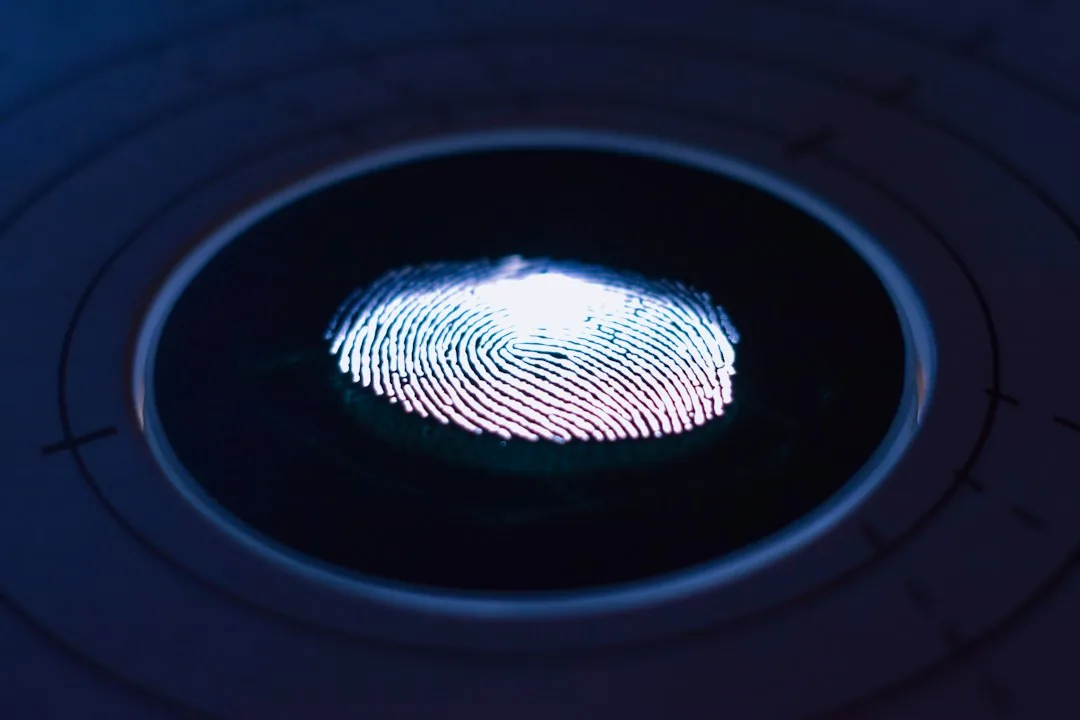
Fingerprint authentication remains the most widely deployed biometric modality in consumer electronics. Modern devices primarily utilize capacitive sensors or ultrasonic sensors to map the intricate topography of a user’s finger.
Capacitive sensors employ arrays of tiny capacitor circuits to collect data about the fingerprint ridges and valleys. Because skin has a different electrical capacitance than air or the insulating material of the sensor, the array maps the exact electrical signature of the ridge pattern. Ultrasonic sensors, conversely, transmit high-frequency sound waves against the finger, measuring the varying echoes that bounce back from ridges and sweat pores. This allows ultrasonic sensors to map subsurface epidermal layers, rendering them immune to surface-level spoofing attempts like high-resolution 2D prints.
Facial Recognition: Structured Light and Neural Networks
Advanced facial recognition systems, popularized by implementations like Apple’s Face ID, elevate authentication security by transitioning from simple 2D image matching to complex 3D depth-mapping.
The authentication sequence begins with a flood illuminator projecting invisible infrared light onto the user’s face to capture a reliable image even in total darkness. Next, a dot projector casts over 30,000 invisible infrared dots onto the face. An infrared camera reads this patterned grid, generating a precise 3D topological map of the user’s facial geometry. This mathematical model is processed by localized neural networks, which dynamically adapt to gradual changes in appearance over time, such as facial hair, aging, or eyewear.
The Architecture of Biometric Privacy and Security
A primary concern regarding biometric authentication is privacy: users fear that their physical data might be harvested, centralized, and compromised in a massive data breach. Robust biometric security architectures mitigate this risk through decentralization and hardware-level isolation.
In industry-standard implementations, raw biometric data never leaves the device, nor is it transmitted to cloud servers. Instead, devices utilize specialized hardware components—such as Apple’s Secure Enclave or an Android device’s Trusted Execution Environment (TEE). These secure zones operate on isolated microprocessors with restricted memory access. Even if malicious software compromises the primary operating system, the underlying cryptographic keys and biometric templates remain entirely inaccessible.
// Conceptual representation of local hardware isolation
[Biometric Sensor]
       │ (Raw Data)
       ▼
[Secure Enclave / TEE] ──(One-Way Hash)──► [Local Template DB]
       │
       └──────(Success/Failure Boolean)──────► [Main Operating System]
Frequently Asked Questions
Can biometric authentication be spoofed by high-resolution photos or fake fingerprints?
While early facial recognition systems could be bypassed using printed photographs, modern 3D structured light systems incorporate liveness detection. They verify depth, infrared reflectivity, and even micro-movements such as blinking. Similarly, modern capacitive and ultrasonic fingerprint readers check for electrical conductivity, blood flow, or deep subsurface layer topography, making basic rubber or gel fake fingerprints ineffective.
What happens if my biometric template is compromised?
Unlike a compromised password, which can be instantly reset, you cannot change your biological fingerprint or facial geometry. However, because enterprise and consumer-grade security systems do not store your actual fingerprint or face image—they store an encrypted, one-way mathematical hash of extracted features—even if that local template were somehow leaked, it cannot be reverse-engineered back into an image of your face or finger.
Is biometric authentication more secure than passwords?
Biometric authentication significantly outperforms standard passwords in real-world scenarios because it eliminates human vulnerabilities such as weak passphrases, credential reuse, and susceptibility to social engineering or phishing attacks. When paired with multi-factor authentication (MFA) frameworks, biometrics provide a frictionless yet mathematically rigorous security posture.
Conclusion and Next Steps
Biometric authentication security successfully bridges the persistent gap between robust cryptographic protection and seamless user experience. By relying on hardware-isolated processing, liveness detection, and mathematical templates rather than static text secrets, technologies like fingerprint sensors and facial mapping protect modern digital assets from unauthorized access.
To further secure your digital ecosystem, audit your personal and organizational devices to ensure that hardware-backed biometric verification is enabled across all primary applications, password managers, and device unlock mechanisms.
Recommended Hardware for Security & Privacy
Zero-trust physical keys, encrypted offline storage, and privacy shields recommended by IT pros.

YubiKey 5 NFC Hardware Security Key
FIDO2 and WebAuthn certified. Provides unbreakable phishing-proof two-factor authentication for password managers and cloud accounts.
Apricorn / Kingston Encrypted USB Flash Drive
Hardware-based AES-256 encryption with physical keypad PIN. Keeps your password database and private keys physically secure.
Ultra-Thin Webcam Privacy Cover Sliders (6-Pack)
Micro 0.027-inch sliding shutter. Mechanically prevents camera snooping and accidental video leaks on laptops and monitors.
Mission Darkness Faraday Signal Blocking Bag
Military-grade RF shielding. Instantly blocks cellular 5G, GPS tracking, Wi-Fi, Bluetooth, and RFID signals from your phone.
Disclosure: BriteHacks is reader-supported. When you buy through links on our site or deploy infrastructure, we may earn an affiliate commission at no extra cost to you. As an Amazon Associate, we earn from qualifying purchases.